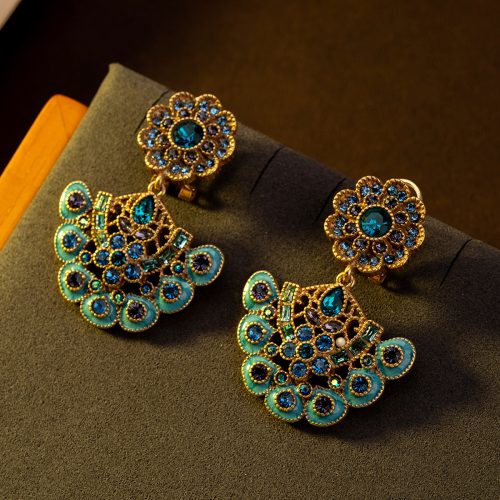
Is gold-plated still real gold?
Is gold plated earrings still real gold? – Critical discussion of its nature, value and morality
‘Gold Plating’ is such a delightfully complex concept, both in the real world and in the realm of metaphor. When you get hold of a shiny gold-plated jewelry or an upscale high-end gold-plated time-piece, the first question that comes in your mind is, is it really gold?
The short answer is yes, but with a very important caveat: the gold-plated layer is real gold (type 18k or 24k, in most cases), but the base metal is harder and a different color than pure gold. Mere posithesis, “Yes, said” or “No, said” will efface the complex and provocative technical, material and cultural hallmarks of this term. To deeply understand gold plating, let us follow the traces of it and analyse the degree of it.
The first layer: the law of physics and the law of chemistry – absolute pure gold.
And at the most fundamental scientific level, the gold-plated layer is gold.
Defination of gold: Gold is a chemical element with symbol Au and atomic number 79. It is a soft, silver-white, corrosion-resistant and highly ductile metal. Real Gold As long as that substance’s atom is gold (Au), then it’s real gold whether they come in the form of gold bars, gold powder, or the very thing that is too thin barely seen by the naked eye.
Pink gold plating process: Gold plating is the electro-deposition or chemical reaction process of covering the surface of objects with a thin layer of gold. Electroplating is generally adopted as a process:
· Workpiece: Material to be plated, usually a cheap metal such as copper, brass, silver, or even nickel.
· The Electrolyte (electrolyte): A solution that contains gold ions (Au+ or Au³+) Electrolytes are usually about double or at least 1.5 times the overall concentration of the plating metal that you want to plate.
· Ongoing Electric Current: Once the current is running, the object to be plated serves as a cathode, attracting positively charged cyanide ions.
· Deposition: Gold ion gets electron at the cathode,to be the gold atom, deposits on the object surface layer by layer, until the gold film to form.
In such a process, the layer deposited on the surface of the article there is made of a chemical composition of 100% gold (or an alloy of gold and other metal(s), e.g., the rose gold plating having the alloyed composition of gold and oi there metals) in which the crystal structure thereof is same as that of the gold derived from the mine. So, in terms of material science, the gold-plated layer does count as real gold.
The second layer: reality/vazkHz value – “True”, but “Extremely” and “Ephemeral”

The gold 22k plating is definitely real gold but it becomes a bit of a challenge if we consider whether it is the best thing or not or whether it is worth it in the long term when thinking about the issue of value, longevity and functionality. The “true” here must be heavily qualified.
The tiny amount – the little goes a long way is the first thing to know about value of gold plating. The thickness of the gold plating layer in the art is mostly in the micron
· Gold-plated jewelry: Plating thickness is between 0.05 and 0.5 microns. This would imply that its gold content is likely just a few grams, if not less. Its gold value is nearly no, and maybe worth a few of cents, or a few RMB.
C High-quality gold plating (like some watches): the thickness can reach 2-5 microns or even more (more than 10 microns can be called “thick gold plating”). Even so, however, its weight in all is only nine cows and one hair, compared with a mass of gold of like volume.
So the value of a gold-plated article is closely related to its matrix, process, design, brand, function, the gold content on its surface is relatively small. “All those who buy them, whether they are rich or poor, get cheated, since they give a lot of money for something that isn’t real gold,” Rivas claimed in his document, “and most of them also use the savings of a lifetime or go into debt.” Most of the money you are paying isn’t actual gold but “handicrafts covered with an extremely thin layer of gold.”
The problem of durability – the beauty of the impermanent Gold in itself is quite durable, but the weak point of the gold-plated (K18 coating) layer is that it is extremely thin. ( it will be worn by wear, rubbing, swimming, antiperspirant and other factors of peeling, and different metal, different way, it will peel ). This is in stark contrast to the wear of the Solid Gold. Solid gold-stamped products can be worn for decades, and then times over, but in many cases, gold-plated items are merely temporary and should be treated as such. Its “real gold” brand has an expiration date.
Definition of law and labeling – the need to be and the need not to be “true”. In addition, virtually every country has its own laws relating to the marking of precious metal goods. This gives us a nice solid legal framework to differentiate “gold plating” from “real gold”:
· Solid gold/pure gold: May indicate the Karat in terms of K (such as 14K, 18K, 24K), but is different from the definition of Karat in this article. 24K is pure gold. It must be all gold alloy.
· Gold Plated (Gold Plated /G.E. /G.P.): According to the provisions of the law it is allowed to stamp or mark gold-plated product as “gold-plated”, but not “14K gold” or “18K gold”, because consumers can be deceive that the whole product, in this case, is gold of this purity. It has to specify the core material, “gold-plated copper” for example.
· Gold Filled: More durable technique where a thick sheet of gold foil is mechanically fused onto the base metal. Indeed, it is a lot thicker and contains much more gold than gold plating. The law permits its gold content marking (“1/20 14K Gold Filled,” for example).
· Gold Vermeil: It is a general term that refers to the plating thick layer Gold (generally but not less than 2.5 microns) on sterling sterling silver. It’s a type of high end gold plating.
The law acknowledges that through these clear labels the gold-plated layer is in fact indicative that the item is gold, but it is keen to make clear it is not as golden as the all-gold products to protect consumers from its look.
Layer three: the function dimension — the “real use” more than a monetary consideration
The worth of gold plating is not just the value of the metal itself. In a lot of high-tech arenas, “real” gold-plating serves a material function that can’t be accommodated by anything else.
Good conductivity:Being the most conductive of all metals, gives it the ability to conduct energy as well as transport it through the body without any compromise to your health. This is very important for electronic applications which is calling for reliable low resistance connection between materials.
· Mobile/computer interface such as USB-C, HDMI, memory stick: the shiny material on the “golden finger” of USB-C, HDMI and memory sticks are very thin gold-plated layers. It makes the signal can be transmitted stably when it is inserted and pulled out.
· Per the aerospace and defense industry, the critical electronic contacts and connections in satellites, spacecraft and high performance radar equipment are going to be gold plated to ensure a reliable service in the harshest environments for decades to come.
At this point the “truth” of gold plating is not as a symbol of wealth, but the truth regarding its physical and chemical behavior. What we’re treating here is its “ability” not its “costly”. This flimsy sheet of gold is all that underpins the functioning of the modern digital world — and it is worth far more to humanity as an information carrier than it is as a material.
Good anticorrosion and biocompatibility: Gold is non-toxic to the human body, does not cause sensitisation, and is not corroded by body fluids, so gold plating is very useful in the medical field, such as electrode parts of some surgical instrument and implantable electronic devices (e.g., pacemakers).

In such cases, we are purchasing a performance solution, and the best material to form this solution is gold plating. Its “true” is the truth that functions, and the truth to which it technically holds.
The fourth is the level of culture and metaphor – the philosophical mediation between “true” and “false”
The concept of “gilding” has since far transcended the realm of technology to become a metaphor for culture itself, and one that ultimately influences how we perceive gilded jewels of the physical gold kind, surely.
· “Gilded Age”: An epithet coined by Mark Twain to ridicule the era in which the United State was outwardly rich and sumptuous, inwardly ridden by social problems and corruption at the close of the 19th century. The “gold plating” in this case aptly characterizes the shiny exterior but the raw underneaths. A gold-plated object emblemizes this tension beautifully: it’s gold to the bare eye; but when you scratch its surface; the inside is cheap metal.
· Criticize “gold-plated”: We say it is “gold-plated”, that is, his background at a famous school is very bright, there is no real skill of practical learning; that is, “gold-plated experience”, which means that he looks bright and his essence is shallow.
True gold plating, in this minimized context, has been put to the ultimate test. It is seen as an illusion of reality which is deliberately created by the oppressors, and as an imitation of the reality (diluted of its meaning and [capitalize: the] true value) developed by the oppressors guys. It looks like gold, but it doesn’t carry its muscle, its essential value. Here its “true” is the visually true, but the “false” in the philosophical sense.
Conclusion: A conditional, hierarchical “real”

So, the gold-plated is still gold?
· For chemists: Well, sure that’s a gold atom on it surface.
· For jewellers and appraisers : Yes, but it’s so tiny, & almost valueless, and not durable.
· For engineers: Yes, and it’s “true” is important, because it provides performance that we’ve not been able to replace anything else.
· For philosophers and critics: It is the perfect symbol and metaphor of the “true” gold, and it reveals the eternal tension between appearance and essence.
In the end, gold plating is a form of conditional truth. It informs us that the “authentiality” of things is not an all-or-nothing matter, but a matter of degree, context and intent.
When you purchase a gold plated product you are not investing in an asset but you are investing in a short-lived beautiful jewellery, a cutting edge technology component or a cultural symbol of influence and authority. A proper understanding of, and acceptance of the reality of, this hierarchy leads to an understanding of what gold plating really is – and quite a few other tricky issues. It is, and it is not, pure gold.
Whatsapp :
Email :
You can contact our website at Beauty Jewels: Fashion Necklace
Leave your comment
Related posts